
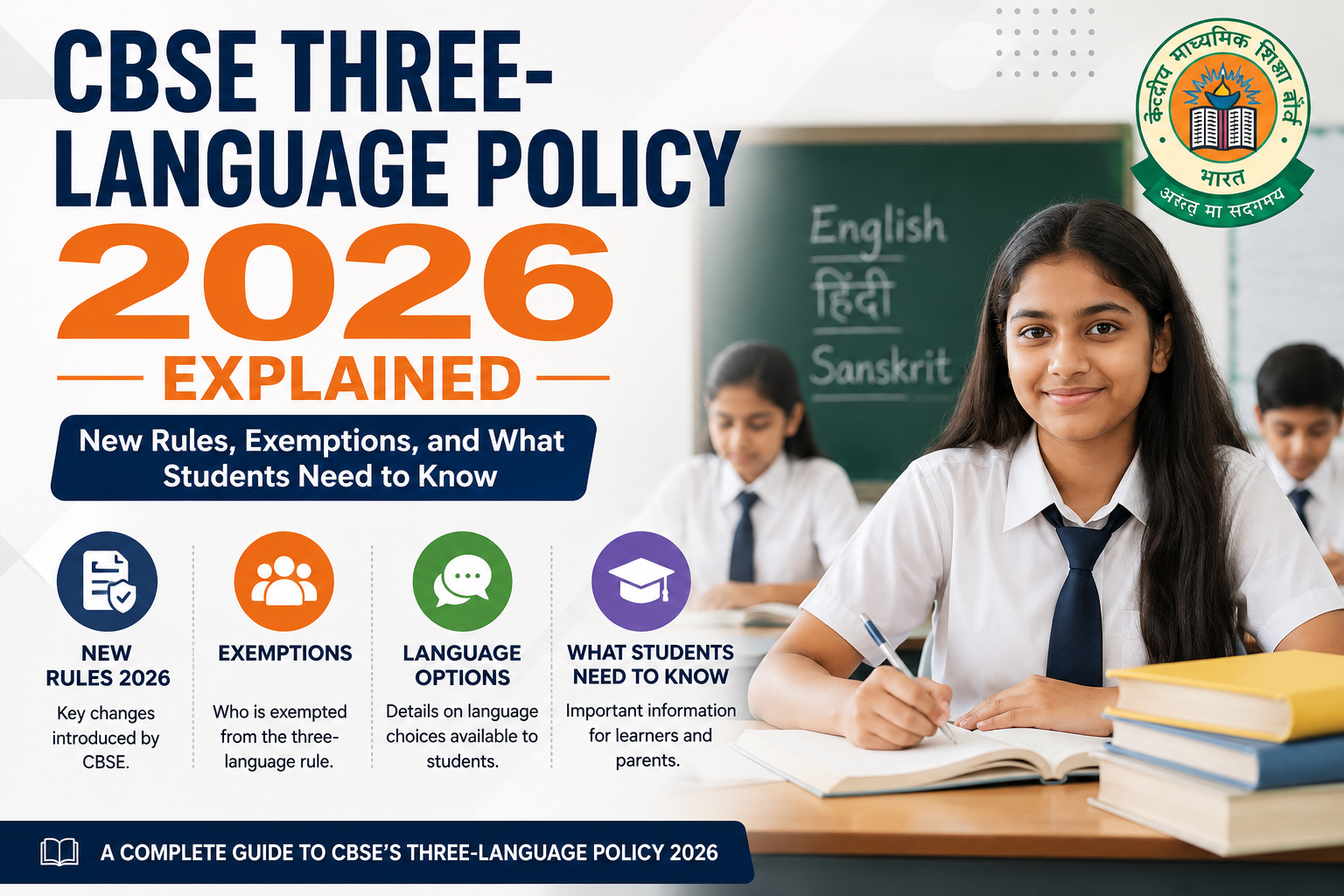
The Central Board of Secondary Education (CBSE) has released fresh guidelines on implementing the Three-Language Policy under the National Education Policy (NEP) 2020. The announcement has generated significant interest among students, parents, and schools across India, especially regarding whether the new rules apply to students already studying in higher classes.
In this article, we explain the latest CBSE Three-Language Policy 2026, who is affected, the exemptions announced by CBSE, and what students should do next.
What Is the CBSE Three-Language Policy?
The Three-Language Policy is part of the National Education Policy (NEP) 2020. It aims to promote multilingual learning by encouraging students to study three languages during their school education.
Under the updated framework, students are expected to study three languages (R1, R2, and R3), with at least two being Indian languages.
Latest CBSE Update
CBSE has clarified that current Class X students will not be affected by the new language requirements. The Board has also stated that the transition will be implemented carefully so that no student faces academic disadvantage.
This clarification comes after concerns from students, parents, and schools regarding the implementation of the new policy.
Key Highlights
- The policy is based on NEP 2020.
- Students will study three languages.
- At least two languages should be Indian languages.
- Current Class X students are exempt from the new requirement.
- CBSE has assured that no student will be academically disadvantaged during the transition.
- Schools will receive implementation guidelines from CBSE.
Who Will Be Affected?
The policy mainly affects students entering the applicable classes under the new academic framework.
Students who are already studying under the previous scheme will generally continue according to the transition guidelines announced by CBSE.
Parents should also check with their respective schools regarding language options available for their children.
Why Has CBSE Introduced This Policy?
According to NEP 2020, multilingual education helps students:
- Improve communication skills.
- Develop better cognitive abilities.
- Understand India’s linguistic diversity.
- Increase future academic and career opportunities.
The policy is intended to strengthen language learning without causing unnecessary academic pressure.
Benefits for Students
Some expected advantages include:
- Better communication skills.
- Stronger understanding of Indian languages.
- Improved cultural awareness.
- Enhanced learning ability.
- Greater career flexibility in the future.
What Should Students and Parents Do?
Students and parents should:
- Read the official CBSE notification carefully.
- Contact their school for language choices.
- Avoid relying on unverified social media posts.
- Keep checking the official CBSE website for future updates.
Important Points at a Glance
| Particular | Details |
|---|---|
| Policy | Three-Language Policy |
| Based On | National Education Policy (NEP) 2020 |
| Languages Required | Three |
| Indian Languages | Minimum Two |
| Current Class X Students | Exempt from the latest requirement |
| Implementation | Phased as per CBSE guidelines |
Frequently Asked Questions
Is the Three-Language Policy compulsory?
CBSE is implementing the policy in accordance with NEP 2020. The exact applicability depends on the student’s class and the transition guidelines.
Are current Class X students affected?
No. CBSE has clarified that students currently studying in Class X are exempt from the latest requirement.
Will students have to change their language immediately?
CBSE has said that the implementation will be gradual and designed so that students are not disadvantaged.
Where can students check official updates?
Students should always refer to the official CBSE website and their school’s official communication.
Conclusion
The latest CBSE Three-Language Policy aims to encourage multilingual education while ensuring that students already studying under the previous system are not negatively affected. The Board has provided important clarifications to reduce confusion and has assured a smooth implementation process.
Students and parents are advised to rely only on official notifications and school announcements for the latest information. As more implementation details become available, schools are expected to provide guidance on language choices and the transition process.

Leave a Reply